One of the most emblematic films directed by Andrey Tarkovsky – Andrey Rublev – has been marked by a particularly complicated production history, according to which, despite being shot in the Soviet Union in 1966, it would not reach Soviet cinemas until 1971, following its premiere at the Cannes Film Festival in 1969. Although presented out of competition, Tarkovsky’s film receives a FIPRESCI prize, i.e., Fédération Internationale de la Presse Cinématographique, or International Federation of Film Critics. From the earliest stages of the film’s production – which proved to be just as complex as its subsequent path to distribution – its history has been the subject of extensive commentary, debate and even controversy.
The troubled production of Andrey Tarkovsky’s films that were made before his trip to Italy in 1980 (a trip that would eventually turn into a forced exile) plays a fundamental role in shaping our perception of the director, even to this day – from a mere soviet filmmaker to a dissident, if not a martyr to art, although Tarkovsky himself would likely have objected to such definitions.
The film, the original title of which had been Strasti po Andreyu (The Passion According to Andrey),[1] coined in the typical Tarkovskian fashion, marked by an unambiguous egocentricity, is structured in eight episodes (novelly), each bearing its own title.[2] Through such a framework, the film portrays a series of key moments in the life of an icon painter Andrey Rublev, alongside several other characters, whose intertwined destinies unfold against the complex and often brutal historical landscape of early fifteenth-century Rus’.
The very idea of turning to the historical figure of Andrey Rublev during the Khrushchev Thaw, does not strike as particularly unusual, if one bears in mind that only a couple years before the start of the scriptwriting, the 1960 was declared by UNESCO the year of the 600th anniversary of the famous icon painter. [3] It becomes thus even more apparent that any Soviet artist – whether writer, filmmaker, or otherwise – who chose to approach a figure of such monumental significance to Russian culture as Andrey Rublev, inevitably shouldered an immense burden of responsibility, not to mention the scarcity of reliable biographical information that has survived to the present day.[4] In the same way, a film narrating the events set within such contradictory and turbulent times of Russian history as those of the first quarter of the fifteenth century (from the summer of 1400 to the spring of 1424), the positive representation of which is by definition a daring but potentially problematic undertaking, would inevitably come under the close scrutiny of such controlling bodies as Goskino USSR[5] and The Central Committee of the Communist Party of the Soviet Union.
Andrey Rublev has been at the centre of many ongoing controversies,[6] having triggered several heated debates about sensitive issues such as (alleged) mistreatment of animals: the infamous burning cow episode was consistently denied by Tarkovsky himself, who dismissed it as an insinuation, as, in fact, did many other members of the film crew. Nevertheless, the episode continues to provoke controversy to this day, due to the lack of direct evidence as to whether the cow was indeed harmed during filming or not. Apart from that, debates surrounding the film also pick at several historical inaccuracies regarding its screenplay, an accusation which, in our view, is not entirely justified, given that historical accuracy in Andrey Rublev was never a primary objective for either Tarkovsky or A. Konchalovsky. Both authors relied extensively on various historical materials and sources relating to everyday life in Rus’ – however, as Tarkovsky himself wrote:
after having completed the script, I had serious doubts as to whether my concept could be realised after all. At the same time, I felt that if it did prove possible, the future film would in no way take the form of a historical or biographical genre. I was after something else – an inquiry into the nature of the poetic talent of a great Russian artist. Through the image of Andrey Rublev, I wanted to examine the psychology of artistic creation and explore the inner state and civic consciousness of an artist who creates certain enduring spiritual values. [7]
The black-and-white cinematography of Andrey Rublev immediately creates a feeling of being drawn into a world that feels both distant and archaic, and so does the setting, reconstructed in the Pskov region and in the city of Suzdal’, along with the distinctively designed and selected costumes. Despite all these visual elements, however, the characters speak perfectly modern Russian, whereas the film itself never depicts Andrey Rublev actually painting his icons. So, what is Rublev occupied with, exactly? He wanders from one place to another, debates with Theophanes the Greek, collects firewood, weeps, observes the pagan rites of Kupala Night, takes a vow of silence, and then hardly makes an appearance in the film’s final episode, which, in fact, comes to focus on Boriska, a young man assigned to cast a massive church bell.[8]
What the soviet authorities, as well as the cultural élite might have taken as a reduction of the cultural and historical stature of Andrey Rublev,[9] in the eponymous film was, for some critics, a very precise and unique artistic device, by means of which Tarkovsky ‘desacralises’ and ‘demythologises’ the image of Rublev, thus allowing the viewers to perceive him above all as a man tormented by earthly feelings and passions, such as guilt, inner crisis, shame, physical sensuality, melancholy, spiritual fragility, fear, and doubt.
Thanks to archival material from the transcript of the artistic council meeting devoted to the discussion of Konchalovsky and Tarkovsky’s script The Beginning and the Path (Andrey Rublev), partially revealed in an article by the Japanese scholar Takahashi Sanami,[10] it becomes clear that the original version of the screenplay, submitted in December 1962 to the First Creative Association of Mosfilm, was met with approval, mostly because of the image of Andrey Rublev, viewed as the embodiment of authentic national culture as well as the ancient Russian epic tradition, the cinematic reappropriation of which seemed to the members of the artistic committee not only appropriate, but necessary.
However, before the film studio gave its final approval for the film to go into production, its screenplay was handed over to the Sixth Creative Association, right where the first critical remarks began to emerge and the first revisions were introduced. At that point, for instance, Tarkovsky and Konchalovsky were compelled to cut down the screenplay, as to remove what was described as “the idealisation of the Church, elements of social amorphousness, and excessive narrative length”.
In a decree issued by the General Director of Mosfilm on June 1, 1964, the censored – and hence approved – version of the screenplay is described as follows:
In [the revised version of the screenplay,] the theme of the artist’s responsibility towards the people is articulated more clearly. In line with this, the solution to the central problem of the screenplay has also deepened, i.e., the problem of the artist as an individual living in society and creating certain moral ideals that were ahead of his time. However, as work on the screenplay continued, the commission recommended that the authors reinforce the theme of national unity and the growing popular resistance to oppression – from without as well as from within. […] It is recommended that several episodes and extended dialogues be reduced […]. The language of the characters also needs adjustment, as it is excessively modernised and includes outright vulgarisms that bear no relation to the actual speech of Rublev’s time. [11]
 The reduction of a number of scenes would accompany the film throughout the entire production process, mostly because some of them would be labelled as “excessively long”, and others “redundant”, to the point of the eventual disinclination of the film studio to go on sponsoring Andrey Rublev, given that its shooting schedule had already been extended. The first issue encountered by the filmmakers following the completion of the film and hence the start of the first closed-door preview screenings, would be the acute criticism towards the so-called excessive violence displayed in certain scenes, which would cause Andrey Rublev to be taken off screens almost immediately. Apart from that, “in the autumn of 1965, [Tarkovsky] gets accused of criminal negligence that nearly resulted in the destruction of the entire museum complex of the Sobor Uspeniya Presvyatoy Bogoroditsy (i.e., the Dormition Cathedral in Vladimir)”.[12]
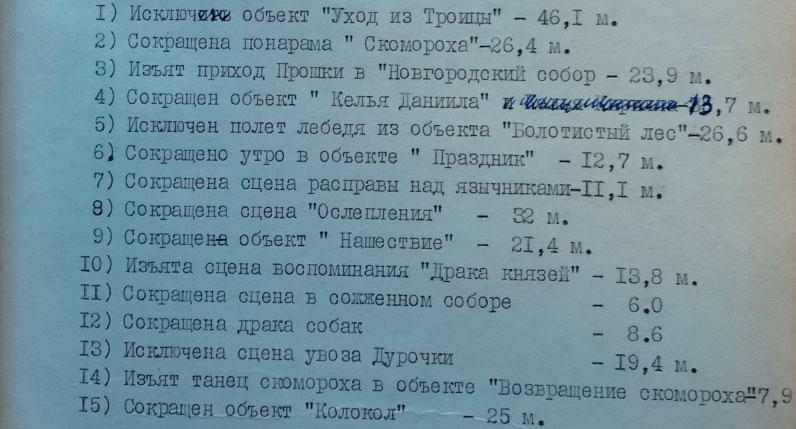
Under the close scrutiny of Mosfilm, the director was forced to make regular revisions to the screenplay: the next demand of the artistic council was to remove scenes featuring “excessive naturalism”, namely the Tatars’ abuse of Durochka (i.e., a holy fool), nudity in the pagan festival scene of the Kupala Night, etc.[13] At the editing stage, Tarkovsky would also be obliged to remove a further number of scenes which, although free of the abovementioned excessive naturalism, were considered by the artistic council to complicate the viewer’s perception of the film, to which the filmmaker responded:
I was saying this at the previous discussion as well, and I am deeply convinced that the relationship with the viewer [in Andrey Rublev] develops through different channels. There is no deliberate desire to be understood by making concessions to the audience. Because of this, much has been removed [from the film], and yet still much is perceived with considerable difficulty. That is a feature of the film. […] Everyone wants it to be lighter, easier to watch. But none of that will actually happen, no matter what we do to this film. It will never be an easy watch, and so the viewer will leave the cinema feeling downcast and emotionally shaken.[14]
Once the film production was completed and the final approval on the part of the expanded commission of the Committee for Cinematography was obtained – not without numerous discussions – the first test screenings took place in preparation for the official release, namely, at Dom Kino (a Cinema House), at the Pravda editorial office and at the CPSU Central Committee. It is noteworthy that precisely at this time (some tend to believe this was done on commission),[15] the popular newspaper Vechernyaya Moskva published, on 24 December 1966, a feuilleton by I. Soldatov, centred on the now notorious episode of the ‘burning cow’, alongside an acute critical attack on the director, whose artistic decisions Soldatov describes as a “loss of a sense of proportion” and the “whims of talent”.[16] As a consequence, Rublev was removed from distribution without reaching a wider theatrical release.
At the meeting of the Bureau of the Artistic Council of the Sixth Creative Association in May 1967, a document from the leadership of the State Committee for Cinematography under the Council of Ministers of the USSR was read out. It stated, above all, that Rublev was subject to strong criticism in Party and public circles of the capital, and finally, that “the film is unquestionably ideologically flawed”.[17] In the document, Tarkovsky was also accused of the film’s lack of historical accuracy, as a result of which “the history of Rus’ between the end of XIV and the beginning of the XV centuries is represented as a time of suffering, public silence, and patience” (Ibid.). The authors of the document argue that the era depicted in Andrey Rublev should be understood primarily as a period of heroic resistance by the Russian people against the Mongol yoke and the emergence of national unity, rather than as a time of internal strife and overall decline.
The criticism further focuses on the film’s tendency to distort the historical image of Rus’ and the Russian people. As a result, Andrey Rublev “offends the dignity of the Russian people, reducing them to savages, almost to animals” by means of emphasising the violence, decline, and spiritual crisis of the era, without however showing the achievements of Russian culture or the conditions that shaped Andrey Rublev’s artistic genius. The fact that ‘Rublev as an artist’ does not even appear in the film, provoked another wave of bewilderment if not genuine irritation. Hence, the document underlines the ‘conventionality’ (uslovnost’) of the artist’s figure, his abstract image as a ‘transcendental’ creator, opposed to society and the people, which by itself seemed ideologically alien to the Soviet worldview. What is defined in the document as the “erroneous ideological concept of the film” is, for Tarkovsky himself, the most important, if not central, concept in the portrayal of Andrey Rublev in the eponymous film. [18] For Tarkovsky, Rublev is a lyrical and tormented artist, whose true strength and genius are embodied in his works – i.e., icons – rather than in external attributes that would be easily legible on screen. Meanwhile, the film’s protagonist is brilliantly portrayed by Anatoly Solonitsyn, whose candidacy at the casting approval stage was met with scepticism by members of the artistic committee, who considered the actor’s track record not particularly impressive.
It is known that Tarkovsky himself did not attend the aforementioned meeting of 1967, due to sick leave, which he was forced to take after the exhausting struggle over his film had significantly undermined the health of the 35-year-old director. And yet, thanks to the publication of archival documents, we know that the film directors present at the meeting included M. Romm,[19] Y. Raizman, G. Aleksandrov, A. Alov, A. Zarkhi, S. Yutkevich and E. Ryazanov, who firmly opposed the arguments that were damaging the film. The transcript of the artistic council meeting shows that they not only recognised the significance of the film itself, but also observed that director A. Tarkovsky’s refusal to make changes was not a matter of mere stubbornness. Rather, he did everything possible to save the film through an acceptable compromise. [20]
The award received in Cannes did not contribute to the issuance of a distribution certificate either. Rather on the contrary, it became yet another reason to delay its release to wide Soviet audiences. It was only in the autumn of 1971 – after a series of further revisions to a film that had, in essence, long been completed – that Andrey Rublev was finally shown in the Soviet Union.
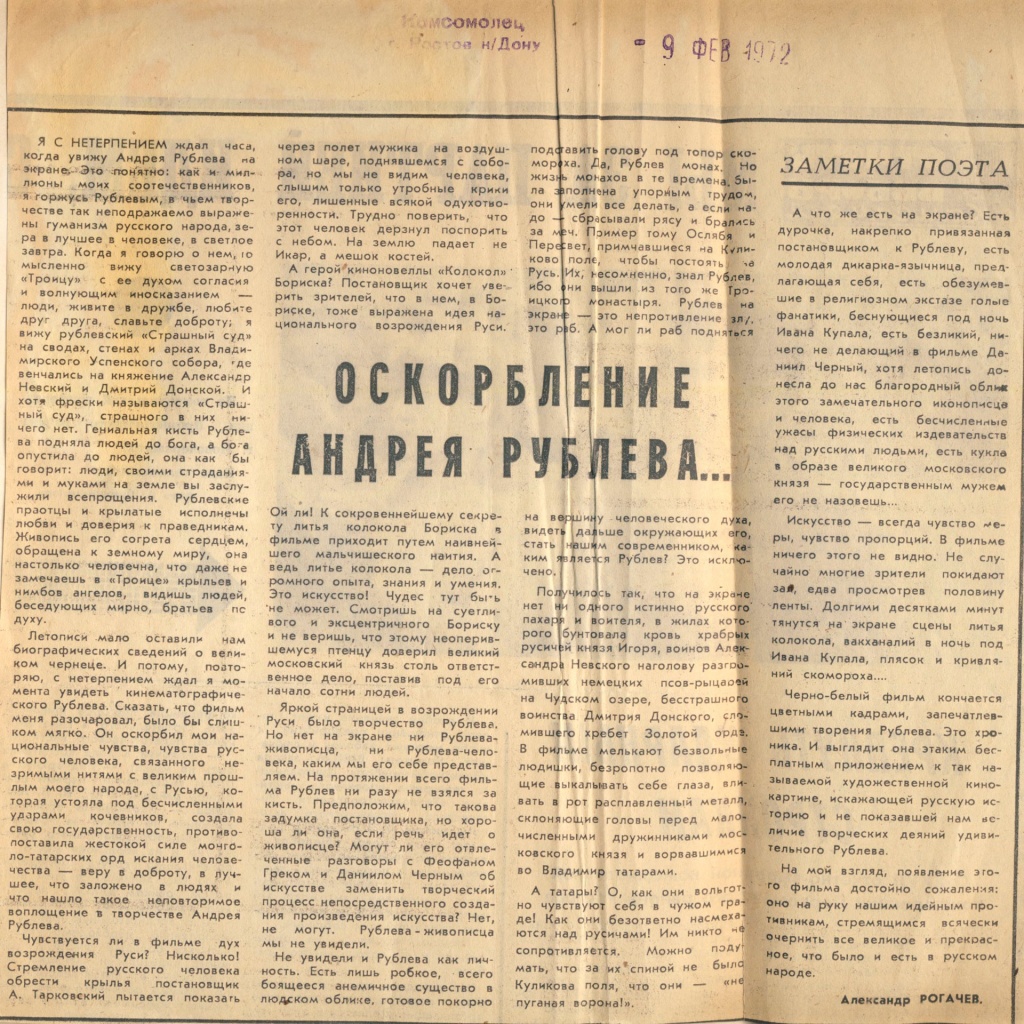
In February 1972, the Rostov newspaper entitled Komsomolets published an article by Aleksandr Rogachev with the telling title “An Insult to Andrey Rublev…”,[21] in which the author expressed deep disappointment with Tarkovsky’s film, noting that “[“Andrey Rublev”] had offended [his] national feelings”. A large number of articles published throughout the 1970s in various Soviet periodicals harshly criticised the film, mostly for its ahistoricism, as well as for the misery and squalor that marked the reality of Rus’ as depicted in Andrey Rublev.
The deeper one delves into the countless articles, feuilletons, essays, and reviews in which the authors, with such remarkable vehemence, repeatedly sought to denounce and condemn Tarkovsky’s film, the more paradoxical it seems that only a few years earlier Andrey Rublev had been met with great success at Western film festivals, having also received the support of such prominent cultural figures as Robert Hossein, Tonino Guerra, Simone Signoret, Yves Montand, Marina Vlady, Michèle Morgan, Gérard Oury, Anouk Aimée, Roger Vadim and so on.
The destiny of Tarkovsky’s Andrey Rublev in both Soviet and post-Soviet distribution stands as a rare example of an almost half-century-long conflict between the artist and his time – from a painful, fragmented path to Soviet audiences marked by ideological tensions, to its recent return and celebration at the Centr Kino (“Cinema Centre”) in Moscow in February 2026, in a 4K restored version, on the occasion of the film’s sixtieth anniversary. And if sixty years ago the film was making its way to the audience amid pervasive censorship, enduring the persistent resistance of artistic committees and the state, today it returns to the big screen as a newly canonised classic, worthy of admiration and recognised as Tarkovsky had originally intended it.
[1] According to archival documents from Mosfilm, partially published on the official website on 10 February 2026, the film’s screenplay was originally titled Nachalo i put’ (The Beginning and the Path).
[2] “Skomorokh”, “Feofan Grek”, “Strasti po Andreyu”, “Prazdnik”, “Strashniy sud” (first part); “Nabeg”, “Molchanie”, “Kolokol” (second part), (“The Jester”, “Theophanes the Greek”, “The Passion”, ”The Holiday”, “The Last Judgement”; “The Raid”, “Silence”, “The Bell”).
[3] Sergey Zagrebin, Ėtika Tarkovskogo, Andrey Rublev, ch. II, ed. V. G. Zagrebina, A. V. Ermolyuk, S. S. Loginovsky, Chelyabinsk, “Rabota plyus”, 2012, p. 45.
[4] The original idea for the film belonged to Vasiliy Livanov, a well-known soviet actor. In collaboration with Andrey Konchalovsky, Tarkovsky began working on the screenplay, and the question immediately arose as to whether a historically grounded biographical depiction of Rublev was desirable at all. See: Marina Kosinova, “Istoriya sozdaniya filma Andreya Tarkovskogo “Andrey Rublev”” (“История создания фильма Андрея Тарковского «Андрей Рублев»”), in Tvorcheskoe nasledie Andreya Tarkovskogo, Vserossiyskiy gosudarstvenniy universitet kinematografii im. S.A. Gerasimova, 2022, p. 95. URL: https://cyberleninka.ru/article/n/istoriya-sozdaniya-filma-andreya-tarkovskogo-andrey-rublev (last accessed 02/06/2026). As noted by Oleg Lekmanov, the lack of reliable information about Rublev’s personality, repeatedly emphasised by historians and art historians, “has proved extremely attractive to most authors writing about this artist. The void can readily be filled with ideas and meanings that are relevant to the author and/or to the historical period influencing them” (Oleg Lekmanov, “Andrey Rublev v russkoy poėzii XX veka. Primery i razbory*” (“Андрей Рублев в русской поэзии ХХ века. Примеры и разборы*”), Studi Slavistici, XXII, 2, 2025, p. 155 (my translation).
[5] USSR State Committee for Cinematography.
[6] Even recently, on 27 November 2025, a one-hour video dedicated to the most famous cinematic myths was published on the YouTube channel of the well-known Russian film critic Anton Dolin (in collaboration with I. Ber), in which particular attention is devoted precisely to Andrey Rublev and the so-called “burning cow” myth. URL: https://www.youtube.com/watch?v=RbB4VVthtj8, at the timestamp 14:20 (last accessed 25/05/2026).
[7] Andrey Tarkovsky, Zapechatlёnnoe vremya, in Аndrey Tarkovsky: Arkhivy. Dokumenty. Vospominaniya, ed. P.D. Volkova, Moskva, “Podkova”, “Ėksmo-press”, 2002, p. 129 (my translation).
[8] The actual works of Andrey Rublev – the icons he painted, the highest achievement of his life and the reason his name is still remembered today – appear only in the final sequence of the film, in colour and in close-up, without text, and accompanied by an ancient Russian choral chant. According to Yu. Mikheeva, the colour in the final scene expresses an aspiration toward figurative Light (Svet), towards which both the viewer and Rublev himself move over the course of the film’s entire narrative” (“Film Tarkovskogo Andrey Rublev i audiovizual’naya paradoksal’nost’ ego finala” (“Фильм Тарковского «Андрей Рублев» и аудиовизуальная парадоксальность его финала”), Vestnik slavyanskikh kul’tur: Teoriya i istoriya iskusstva, 2014, pp. 150-158, URL: https://cyberleninka.ru/article/n/film-tarkovskogo-andrey-rublyov-i-audiovizualnaya-paradoksalnost-ego-finala (last accessed 29/05/2026).
[9] Ilia Sergeevich Glazunov, a Soviet artist (awarded the title of People’s Artist of the USSR in 1980), criticised Andrey Rublev not only for its alleged “anti-historical” and “anti-patriotic” nature, but also for the distorted portrayal of such characters, as Rublev himself and Theophanes the Greek: “In Andrey Rublev, for example, historical truth is distorted. This was the era of the Russian Renaissance, when Rus’ – after long years under Mongol rule – arrived at the Kulikovo battlefield to determine the fate of both Russia and Europe. One of the foremost representatives of that generation was Andrey Rublev, whose name features in the chronicles alongside that of Sergius of Radonezh – a figure who is given no place in the film whatsoever. In the motion picture, Andrey Rublev is depicted as a modernised neurotic – restless, tormented, unable to find his path, lost in his own spiritual quest. In reality, however, Rublev managed to create the most harmonious works, imbued with spiritual light. Works that, during the most difficult moments of our history, offered a moral point of reference to our people. The portrayal of Theophanes the Greek, in its turn, conveys neither greatness nor wisdom. It seems that the authors of the film do not only detest Russian history, but Russia itself, with its rain-soaked land, its mud, its oppressive, foul dampness. Everything seen in this land seems repulsive: its men in coarse linen garments, its tyrannical princes, its monks brutally beating a dog to death with sticks. […] Only the conquerors of the Golden Horde appear truly magnificent, remarkable in the nobility of their bearing and the splendour of their attire. Their mere presence is enough to send this grey, faceless mass of cowardly “common people” fleeing in panic. In short, the film proves to be profoundly anti-historical and anti-patriotic. (Ilia Glazunov, “Kino v moei zhizni” («Кино в моей жизни»), Sovetskiy Ėkran, № 22, Nov. 1984, ed. D. K. Orlov, Moskva, “Pravda”, 1984, pp. 18-19).
[10] Takahashi Sanami, “‘Andrey Rublev’ A. Tarkovskogo: Interpretatsiya russkoy istorii v kontekste sovetskoy kultury” (“‘Андрей Рублев” А. Тарковского: Интерпретация русской истории в контексте советской культуры”), Acta Slavica Iaponica, Tomus 29, Hokkaido University Collection of Scholarly and Academic Papers, 2011, pp. 65-86, URL: https://hdl.handle.net/2115/47629 (last accessed 26/05/2026).
[11] Gayanė Ambarcumyan, “Andrey Rublëv” – Istoriya sozdaniya filma – arkhivnye dokumenty (chast’ 2), “Mosfilm”, 10 Feb. 2026, URL: https://www.mosfilm.ru/about/news/sozdanie-filma-andrey-rublev-arkhivnye-dokumenty-chast-2 (last accessed 26/05/2026) (my translation).
[12] It is known that the “proceedings […] were so serious that the administration of the film crew, under the direction of Andrey Tarkovsky, was forced to send an open letter to the leading Soviet newspaper, Pravda. (“Mosfilm”, 10 Feb. 2026., URL: https://www.mosfilm.ru/about/news/sozdanie-filma-andrey-rublev-arkhivnye-dokumenty-chast-4 (last accessed 26/05/2026)).
[13] For reference, see the Mosfilm archival materials, specifically, the “list of scenes and objects to be reduced”: URL: https://www.mosfilm.ru/upload/medialibrary/fc1/fc117a2e38056e3a4e432d4232ab964c.jpg) (last accessed 26/05/2026). In fact, Andrey Tarkovsky was required to cut at least fifteen scenes, with the total number of revisions exceeding at least (!) thirty-five.
[14] Gayanė Ambarcumyan, “Andrey Rublëv” – Istoriya sozdaniya filma – arkhivnye dokumenty (chast’ 6), “Mosfilm”, 10 Feb. 2026, URL: https://www.mosfilm.ru/about/news/sozdanie-filma-andrey-rublev-arkhivnye-dokumenty-chast-6 (last accessed 26/05/2026) (my translation).
[15] As Andrey Tarkovsky himself wrote in a letter to the Chairman of the State Committee for Cinematography under the Council of Ministers of the USSR, A. Romanov: “I perceive this entire campaign of malicious and entirely unprincipled attacks as a genuine persecution. A real persecution which, in fact, had already begun at the time of the release of my first feature film, Ivanovo Detstvo (Ivan’s Childhood)” […] The creators of Andrey Rublev have found themselves involved in an atmosphere triggered by the insinuating article (evidently prompted by someone), published in Vechernyaya Moskva. […] In an atmosphere so monstrous in its unjust and tendentious nature that I am compelled to address you, as a leading official, to ask for help and to beg you to take all necessary steps to put an end to this persecution. For it is not difficult to demonstrate that the persecution does exist. […] I have the courage to call myself an artist. More precisely, a Soviet artist. […] I am in a constant search, which is difficult, and it brings with it conflicts and problems. It does not allow me to live in peace in a warm and comfortable apartment. It demands courage from me” (Gayanė Ambarcumyan, “Andrey Rublëv” – Istoriya sozdaniya filma – arkhivnye dokumenty (chast’ 8)”, “Mosfilm”, 10 Feb. 2026, URL: https://www.mosfilm.ru/about/news/sozdanie-filma-andrey-rublev-arkhivnye-dokumenty-chast-8) (last accessed 26/05/2026) (my translation).
[16] URL: https://www.mosfilm.ru/upload/medialibrary/5fe/5fe8e358245419c79c1f5bf00cebcaff.jpg.
[17] Gayanė Ambarcumyan, “Andrey Rublëv” – Istoriya sozdaniya filma – arkhivnye dokumenty (chast’ 9), “Mosfilm”, 10 Feb. 2026, URL: https://www.mosfilm.ru/about/news/sozdanie-filma-andrey-rublev-arkhivnye-dokumenty-chast-9 (last accessed 26/05/2026).
[18] “During a meeting of the board of screenwriters and editors of the Sixth Creative Association, Tarkovsky explained “This is the idea. My concept of Rublev’s work is as follows. Andrey Rublev is a fragile, silent, lyrical person – almost as if his work itself suggested it. I believe that within these qualities there is an underlying fiery temperament. And this passionate temperament must emerge outward. It is on this that the final scene is built, with its dramatic music, in analogy with his entire life, marked by sharp contrasts in relation to the calm and monumental frescoes. But there is no coldness […] in this artist. And it is precisely in this way that I wanted to emphasise the difference, so that he could be fully appreciated” (Gayanė Ambarcumyan, “Andrey Rublëv” – Istoriya sozdaniya filma – arkhivnye dokumenty” (chast’ 9), “Mosfilm”, 10 Feb. 2026, URL: https://www.mosfilm.ru/about/news/sozdanie-filma-andrey-rublev-arkhivnye-dokumenty-chast-9) (last accessed 26/05/2026) (my translation).
[19] Romm had also previously intervened in support of Tarkovsky, defending his film concepts, as was the case with Ivanovo detstvo. See Valeriy Fomin, Marina Kosinova, Kak snjat’ shedevr. Istoriya sozdaniya fil’mov Andreya Tarkovskogo, snyatykh v SSSR (Как снять шедевр. История создания фильмов Андрея Тарковского, снятых в СССР), Moskva, Kanon+, 2016, pp. 156-157.
[20] Gayanė Ambarcumyan, “Andrey Rublëv” – Istoriya sozdaniya filma – arkhivnye dokumenty” (chast’ 9), “Mosfilm”, 10 Feb. 2026, URL: https://www.mosfilm.ru/about/news/sozdanie-filma-andrey-rublev-arkhivnye-dokumenty-chast-9 (my translation).
[21] URL: https://www.mosfilm.ru/upload/medialibrary/129/129c77b2e1c087dce94e511c9d5ca5c8.jpg (last accessed 26/05/2026).
Bibliography
Ferdori, Donato, “Nei luoghi di Tarkovskij”, Cinema & musica, 10 June 2022 (URL: https://www.mimesis-scenari.it/2022/06/10/nei-luoghi-di-tarkovskij/) (last accessed 03/06/2026).
Fomin, Valeriy, Kosinova, Marina, Kak snyat’ shedevr. Istoriya sozdaniya fil’mov Andreya Tarkovskogo, snyatykh v SSSR (Как снять шедевр. История создания фильмов Андрея Тарковского, снятых в СССР), Moskva, Kanon+, 2016.
Glazunov, Ilia, “Kino v moey zhizni” [«Кино в моей жизни»], Sovetskiy Ekran, no. 22 (November 1984), ed. D. K. Orlov. Moskva, Pravda, 1984, pp. 18-19.
Kosinova, Marina, “Istoriya sozdaniya filma Andreya Tarkovskogo Andrey Rublev” [“История создания фильма Андрея Тарковского «Андрей Рублев»”], Tvorcheskoe nasledie Andreya Tarkovskogo, Moskva, Vserossiyskiy gosudarstvenniy universitet kinematografii imeni S. A. Gerasimova, 2022, pp. 95-104 (URL: https://cyberleninka.ru/article/n/istoriya-sozdaniya-filma-andreya-tarkovskogo-andrey-rublev) (last accessed 02/06/2026).
Lekmanov, Oleg, “Andrey Rublev v russkoi poėzii XX veka. Primery i razbory*” (“Андрей Рублев в русской поэзии ХХ века. Примеры и разборы*”), Studi Slavistici, XXII, 2, 2025, pp. 155-176 (URL: https://doi.org/10.36253/Studi_Slavis-17688) (last accessed 02/06/2026).
Mikheeva, Yuliya, “Film Tarkovskogo Andrey Rublev i audiovizual’naya paradoksal’nost’ ego finala” (“Фильм Тарковского «Андрей Рублев» и Аудиовизуальная Парадоксальность Eго Финала”), Vestnik slavyanskikh kul’tur: Teoriya i istoriya iskusstva, 2014, pp. 150-158 (URL: https://cyberleninka.ru/article/n/film-tarkovskogo-andrey-rublyov-i-audiovizualnaya-paradoksalnost-ego-finala) (last accessed 29/05/2026).
Misharin, Aleksandr, “Na krovi, kul’ture i istorii…” («На крови, культуре и истории…»), O Tarkovskom, ed. M. A. Tarkovskaja, Moskva, Progress, 1989.
Nekrasov, Viktor, “Festival’ filmov Andreya Tarkovskogo v Parizhe” («Фестиваль фильмов Андрея Тарковского в Париже»), Novoe Russkoe Slovo, 18 March 1984, № 26421, New York, 1984 (URL: https://nekrassov-viktor.com/images/Books/Festival-filmov-Andreya-Tarkovskogo-v-Parizhe/18_03.1984.jpg) (last accessed 26/05/2026).
Sanami, Takahashi, “‘Andrey Rublev’ A. Tarkovskogo: Interpretatsiya russkoy istorii v kontekste sovetskoy kultury” (“«Андрей Рублев» А. Тарковского: Интерпретация русской истории в контексте советской культуры”), Acta Slavica Iaponica, Tomus 29, Hokkaido University Collection of Scholarly and Academic Papers, 2011, pp. 65-86 (URL: https://hdl.handle.net/2115/47629) (last accessed 26/05/2026).
Tarkovsky, Andrey, Zapechatlёnnoe vremya, (Запечатленное время), Аndrey Tarkovsky: Arkhivy. Dokumenty. Vospominaniya, ed. P.D. Volkova, Moskva, “Podkova” (“Ėksmo-press”), 2002, 464 p.
Teneishvili, Otar, “Kannskie i parizhskie tayny “Andreya Rubleva”” («Каннские и парижские тайны «Андрея Рублева»»), in Nostalgiya po Tarkovskomu, ed. Ya. Yaropolov, Moskva, 2007, pp. 156-158 (URL: https://stiv-berg.livejournal.com/56343.html) (last accessed 26/05/2026).
Zagrebin, Sergey, Ėtika Tarkovskogo (Этика Тарковского), Andrey Rublev, ch. 2, ed. V. G. Zagrebina, A. V. Ermolyuk, S. S. Loginovsky, Chelyabinsk, “Rabota plyus”, 2012.
Online sources
Andrey Tarkovsky: pro et contra (URL: https://andreytarkovsky.rhga.ru/) (last accessed 02/06/2026).
Gayanė Ambarcumyan, “Andrey Rublëv” – Istoriya sozdaniya filma – arkhivnye dokumenty” (v 10 chastyakh), “Mosfilm”, 10 Feb. 2026 (URL: https://www.mosfilm.ru/about/news/andrey-rublev-istoriya-sozdaniya-tsikl-publikatsiy-po-materialam-arkhiva-kinokontserna-mosfilm-chast/) (last accessed 26/05/2026).
Media-arkhiv “Andrey Tarkovskiy” (URL: http://tarkovskiy.su/) (last accessed 02/06/2026).
________________
@Sofiia Solokhina (Università di Pisa)
[28 maggio 2026]
Sofiia Solokhina, Tarkovskij and Censorship: the Destiny of “Andrej Rublëv”, in Voci libere in URSS. Letteratura, pensiero, arti indipendenti in Unione Sovietica e gli echi in Occidente (1953-1991), Edited by Claudia Pieralli e Marco Sabbatini, Firenze, Firenze University Press, 2021-. ISSN 2704-5870 (online), eISBN 978-88-5518-463-2, DOI 10.36253/978-88-5518-463-2 (aggiornamento 31/05/2026)
 open access