“If each of us lights a match,
it will be enough to illuminate half the sky.”
Bananan, Assa
As one of the defining and most iconic films of Perestroika – Assa – is approaching its fortieth anniversary, marking the ever-growing gap separating that bygone era and the present, it also serves as a reminder of the passing of its acclaimed director, Sergei Solovyov, on 13 December 2021. The first film in the trilogy made by Sergei Solovyov between 1987 and 1991, Assa achieved remarkable success, having retained its cinematic significance over time, as is often the case with works of art that manage to capture and reflect the Zeitgeist of an era, eventually attaining a cult status.
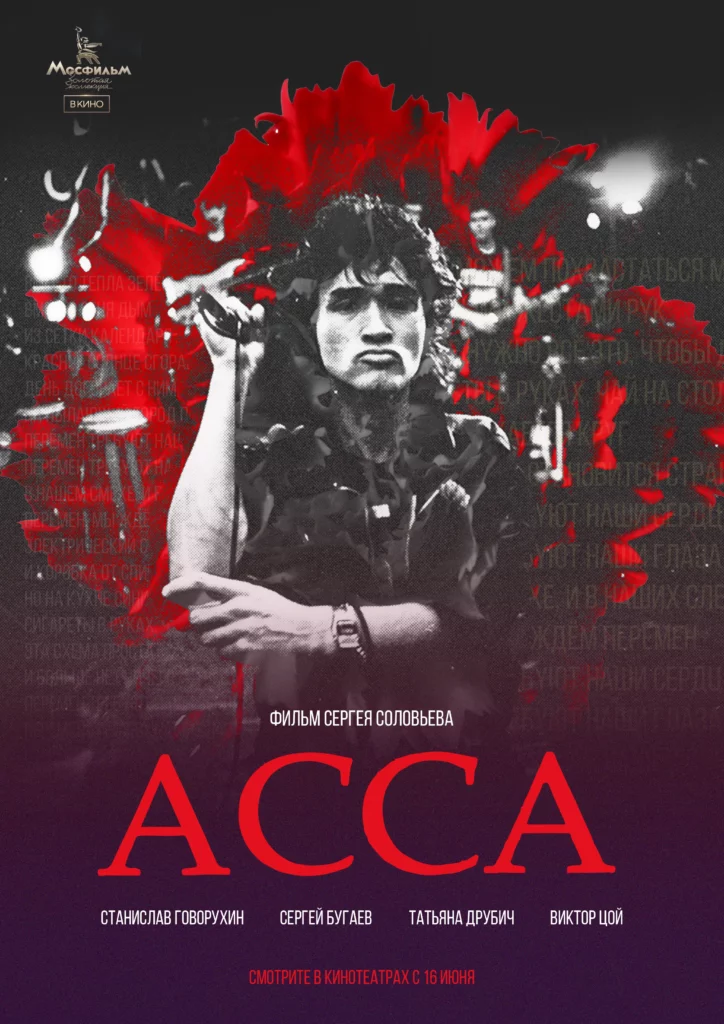
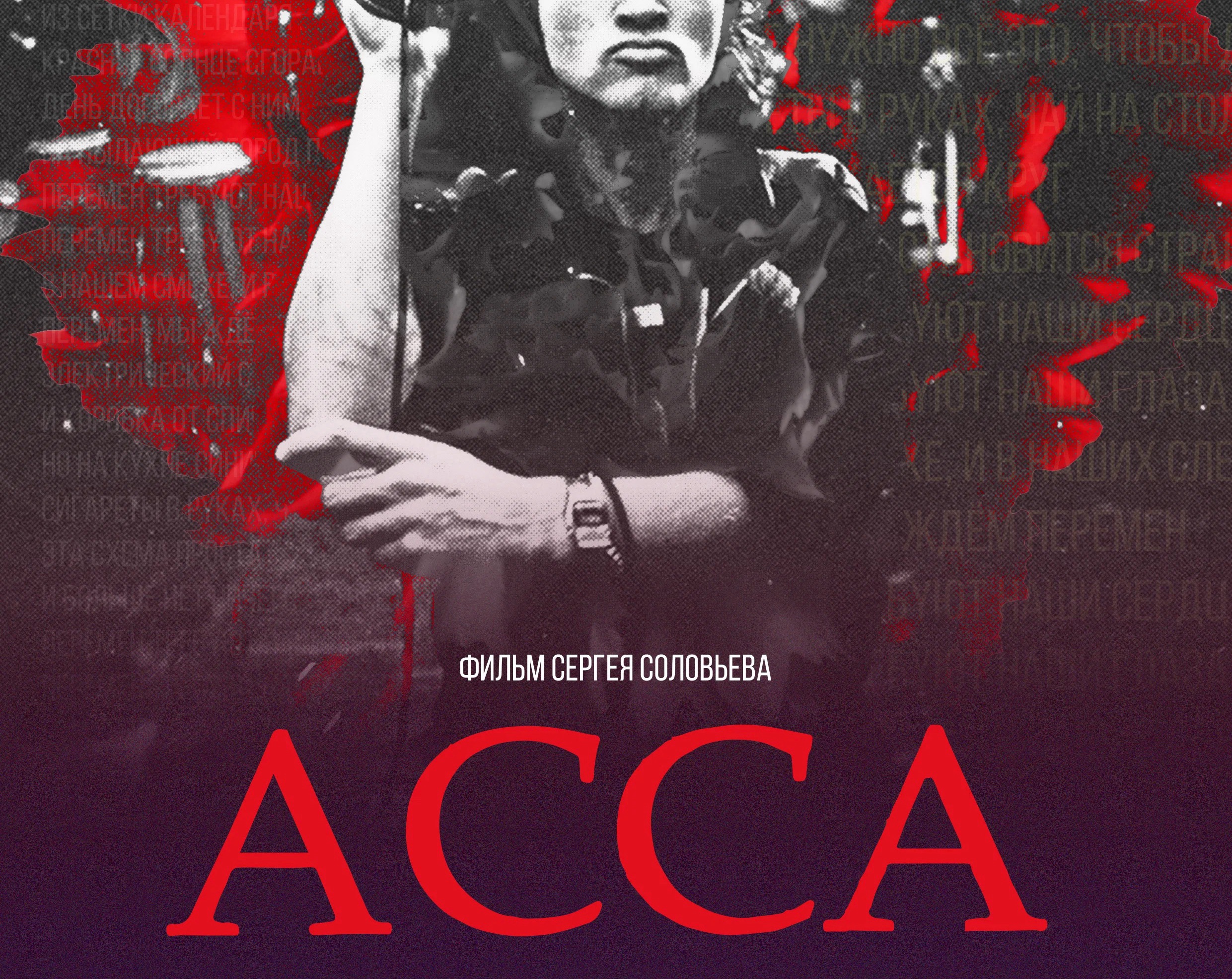
Film Poster for Assa, Mosfil’m, 1987
Depicting some of the most critical turning points of the late Soviet period, Solovyov’s film represents an original expression of the cultural climate of Soviet Perestroika, embodying its nonconformist spirit, countercultural tendencies, and the emerging perception of profound changes in Soviet social norms and everyday life (Mangiullo 2021).
Occupying a singular place even within the trilogy it makes part of, Assa is often viewed as a defining cinematic landmark, a work of extraordinary artistic merit that came to embody the aspirations and contradictions of an entire generation of Soviet people. It is not the genre, however, that makes Assa a pioneering work that stands out among the films of its time; from a narrative and thematic standpoint, the film is essentially a drama centered on a love triangle with elements of a crime story – such a premise was neither particularly sophisticated nor uncommon in late-Soviet cinema. One might as well recall Stanislav Govorukhin’s 1987 film adaptation of Agatha Christie’s And Then There Were None, starring Tatiana Drubich once again in a leading role. In Assa, it is the extraordinary refinement of the visual style that distinguishes it the most: the hazy urban landscapes, the delicate pastel tones, the lingering shots, and the slow visual flow set against a contrasting narrative pace. The film’s dialogues – another product of the brilliant screenplay co-authored by Sergei Solovyov and the young Sergei Livnev – combine obscurity with irony, appear at times obscene yet poetic. Finally, it is the musicality and abstraction of the narrative structure that shape both the film’s atmosphere and the distinctive language spoken by its central characters.
In 1950, as a teenager, Sergei Solovyov moved to Leningrad with his family, where he would later establish some of the most important artistic connections of his career, such as the one with Boris Grebenshchikov, the leader of the famous rock band Akvarium. In fact, it was Grebenshchikov who introduced Solovyov to the young Leningrad artist Sergei Bugaev, known as “Afrika,” who would eventually go on to portray the protagonist of Assa – a role originally intended for the musician himself. Regardless of the artistic value of Afrika’s contribution, his presence is essential to the film’s underground identity, accentuating the tension between the “Soviet” and the “post-Soviet,” between the “old” and the “new,” even though the contradictory and uncertain concept of the “new” had yet to take shape in late Soviet reality and eventually redefine it.
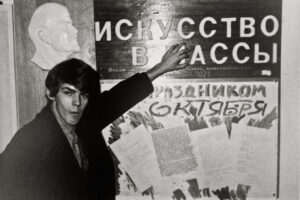
Sergei Bugaev, known as “Afrika,” with the poster Iskusstvo v mASSY (Art to the Masses).
The film features five songs by Akvarium that go beyond the role of mere background accompaniment, for they become active agents in the narrative, shaping its development and giving expression to the characters’ inner worlds. For instance, the famous song Gorod zolotoj (‘The Golden City’), marked by its distinctive melancholic melody, underscores the scene in which Alika and Bananan ride a funicular, therefore the viewer immediately perceives the deep bond between the two characters as well as their mutual affection, even though no words are exchanged between them. Another song, Mochalkin Blues (‘Mochalkin’s Blues’), is yet another provocation by Bananan’s band in the film, designed to offend and humiliate Krymov in front of Alika. With the same intention, later in the film, during the boat scene, Bananan’s band performs Starik Kozlodoev (‘Old Man Kozlodoev’), the lyrics of which openly insult Krymov, ultimately prompting his intervention in the platonic relationship between Alika and Bananan. Akvarium’s collaboration with Sergei Kuryokhin – an improvising musician, avant-garde composer, performance artist, provocateur, Soviet intellectual, and leader of the band named Pop-Mekhanika – on the arrangements of several songs featured in the film is especially memorable, particularly his piano accompaniment in Mochalkin Blues.
It is the avant-garde language that makes Assa seem a post-Soviet – or rather, a “non-Soviet” fantasy – revealing a dimension of artistic life that had previously existed only on the margins, the so-called underground culture, which had never been given the opportunity to find expression on the big screen or reach a wider public in the Soviet Union. The very title of the film itself – Assa – refers to Moscow and Leningrad youth slang, where the term supposedly denoted a situation of confusion, unrest, and disorder (sumbur, sumatokha, nerazberikha) (Smirnova 1988: 12). In fact, the title was suggested by Afrika, who, according to a widely circulated interpretation, also conceived it as an acronym for “Avtor Solovyov Sergei Aleksandrovich” (“Author Solovyov Sergei Aleksandrovich”).
The apartment of the protagonist (nicknamed ‘Malchik Bananan’), just like his band, functions in the film as a symbolic representation of the Soviet underground scene – a limited space of freedom, offering an escape from censorship, ideological conformity, and the constraints placed on artistic expression in Soviet society (Mangiullo 2021). It becomes a refuge for those seeking new forms of self-expression and aspiring to greater personal freedom, ultimately leading them to break away from the life patterns inherited from the previous generations. This is not, however, a classic example of a mere youthful rebellion, but a profound and acute recognition of the necessity of transforming and redirecting one’s own present and future. It is noteworthy that the final scene of Assa, in which Viktor Tsoi, the leader of the rock band Kino, performs the song Peremen (literally, ‘Changes’), is widely considered the film’s leitmotif, if not the very ideological core of the entire motion picture. The persistent desire of younger generations of Soviet citizens for substantial transformations in the sociopolitical life of their country is understood here not so much as an ideological aspiration, but as a manifestation of the growing realization that the Soviet reality was inevitably approaching its decline. Many critics have questioned this interpretation, arguing that Viktor Tsoi’s presence in the film was simply aimed at attracting younger audiences, as Kino was an exceptionally popular band at the time, particularly among young people. The very concept of ‘change’, however, proved to be a powerful slogan after all, one that was easily understood, deeply relevant, and instantly recognizable to Soviet youth. In a 2011 interview, Solovyov himself noted that the song-slogan Peremen suggested by Kino and chosen for the film’s finale, was not such a clear-cut moment for its director:
crying out “Changes!” is one thing, but defining the nature of those desired changes is an entirely different question. I was there on the set myself, right among the crowd shouting, “Changes! We want changes!” And at that moment I asked myself: but what changes, exactly? Somehow, I pushed this question aside, it proved to be persistent and significant, ultimately leading me to make Assa-2 (Olenev, Solovyov 2015).
Indeed, shortly before the collapse of the Soviet Union in 1991, very few – especially among the younger generation – could have anticipated that the Russian reality of the 1990s would turn out to be far less optimistic than they had imagined. The decade that followed the collapse, known in Russia as the “wild” 1990s (likhie devyanostye), is widely remembered as a time of profound social and economic upheaval, a sharp deterioration in living standards, along with increasing levels of organized crime and violence in everyday life.
As for other symbolic elements in the film, particular attention should be paid to several iconic art pieces featured in the protagonist’s apartment, namely Kommunikatsionnaya truba (‘Communication Pipe,’ 1975) and Zheleznyi zanaves (‘Iron Curtain,’ 1975), both of which are displayed in Bananan’s room together with other abstract artworks and objects. The pieces are genuine creations by the members of Gnezdo (lit., ‘The Nest’), a conceptual art collective formed in 1975 by Mikhail Roshal (1956-2007), Gennady Donskoy (b. 1956), and Viktor Skersis (b. 1956). Kommunikatsionnaya truba represents a primitive metal tubiform device, designed to enable two people to exchange their most intimate thoughts and ideas.[1] Meanwhile, ‘Iron Curtain’ refers to the widely recognized metaphor used to describe the political divide separating communist Eastern Europe from the West from the end of the Second World War until the conclusion of the Cold War in 1991. Both works therefore reduce the complex political concepts behind these artworks to simple physical objects, emphasizing their almost primitive materiality.
The ‘Pipe’ can be interpreted as a symbol of glasnost (i.e., freedom of expression, openness), representing the only “legitimate” means of expressing and sharing ideas in a society where the expression of certain ideas was restricted, and public opinion was often silenced or marginalized. ‘Iron Curtain’, in its turn, embodied the complex theme of the strained relationship between the Soviet Union and the so-called ‘outside world’; the impossibility of crossing or seeing beyond this metaphorical wall generated in some a claustrophobic sense of confinement, isolation, and alienation. In Assa, both artworks operate not as mere background decoration, but as significant recurring elements with specific and deliberate narrative functions. For instance, the ‘Pipe’ is used twice as a communication device between three different characters in the film: first, Alika uses it to tell Bananan the story of her relationship with Krymov; eventually, she keeps it as a gift from Bananan – a person she loses forever by the end of the film, having never openly expressed her feelings toward him.
The function of the ‘Iron Curtain’ is different: serving as the door of Bananan’s room, it produces a loud metallic clatter whenever someone accidentally hits it – the artwork can therefore be understood as an object of ridicule and demystification, serving to diminish the symbolic seriousness of the divide between Soviet reality and the West. Another artwork featured as part of Bananan’s room is Pal’ma v snegu (‘Palm Tree in the Snow’). A paradoxical image in itself, it was created by Nikolai Ovchinnikov in 1985 and was originally titled Vsyo khorosho (‘Everything Is Fine’). The artwork resonates strongly with the film’s imagery, with its the snow-covered Crimean landscapes and their melancholic, out-of-season stillness gradually intensify throughout the narrative, culminating in a paroxysmal ending. And if Ovchinnikov optimistically suggests that ‘Everything is fine’, the same does not apply either to Bananan, or Alika, or Krymov, whose destinies ultimately take a dramatic turn.
From an avant-garde perspective, any object can be transformed through its representation to the point of acquiring an absurd dimension. Throughout the film, Solovyov freely deconstructs and recombines a range of cultural references, offering the viewer a new perspective on the complex mosaic of emotions and symbols that defined his time. In this respect, the film can be understood as an avant-garde work of cinema.

Film still from Assa, featuring Kommunikacionnaja truba (Communication Pipe), an art object by the Gnezdo group.
The central Crimean storyline is continually interrupted by episodes derived from a historical novel written by Natan Eidelman, and devoted to the final days of Tsar Paul I’s life and reign. Such a choice may seem unexpected considering the general framework of the film, marked by its pure and at times even extreme modernity. [2] In a 1988 interview for “Iskusstvo kino”, Sergei Solovyov defined the film’s chronotope as the performative space of a parallel cinematic reality (Solovyov, Dondurei 1988: 6-20). The forms of naturalistic and philosophical absurdism present in the film belong to a tradition that found one of its highest literary expressions in the oeuvre of Daniil Kharms and his successors, whose poetry, prose, and comic sketches combined the absurd with infantilism, surrealism, black humor, alogism, and zaum (i.e., ‘transrational language’).
According to Mariya Bezenkova, in the film “History (as objectified time and space) no longer reveals itself through the [protagonist’s] personality. Instead, it emerges as a separate, faceless, yet remarkably powerful character – an equivalent of the ancient Greek notion of fate (rok).[3] […] In the cinema of that period, individuals were already free to exist beyond historical Time, free to inhabit a fantastical space rather than a real one, thereby adopting the corresponding modes of perception. […] Above all, [the character] sought to preserve an inner core and a distinct sense of individuality and […] displayed a certain irreverence in what he did, what he said, and the way he interacted with other characters” (Bezenkova 2011: 85-89).
And indeed, the reality that the protagonist of Assa seems to inhabit is a fantastical one, if not an altogether bizarre or absurdist one – rather than understanding his own life as reality, he perceives himself as existing within the realm of dreams. In fact, the film features several of these dreams, whose sheer vividness and almost fantastically chaotic imagery are remarkable for their beauty. He refers to Grebenshchikov as “a god,” saying that “there is a radiance that emanates from him,” he writes the “eternal book,” destined to survive the apocalypse, and creates rather provocative New Wave songs, performed in a distinctive manner seemingly inspired by Sergei Kuryokhin’s Pop-Mekhanika. He wears his glasses with no lenses in them, arguing that “it is not the lenses that matter; what matters is the sense of oneself as a person who can see” (“glavnoe – ne stekla; glavnoe – oshchushchat’ sebya zryachim chelovekom”).
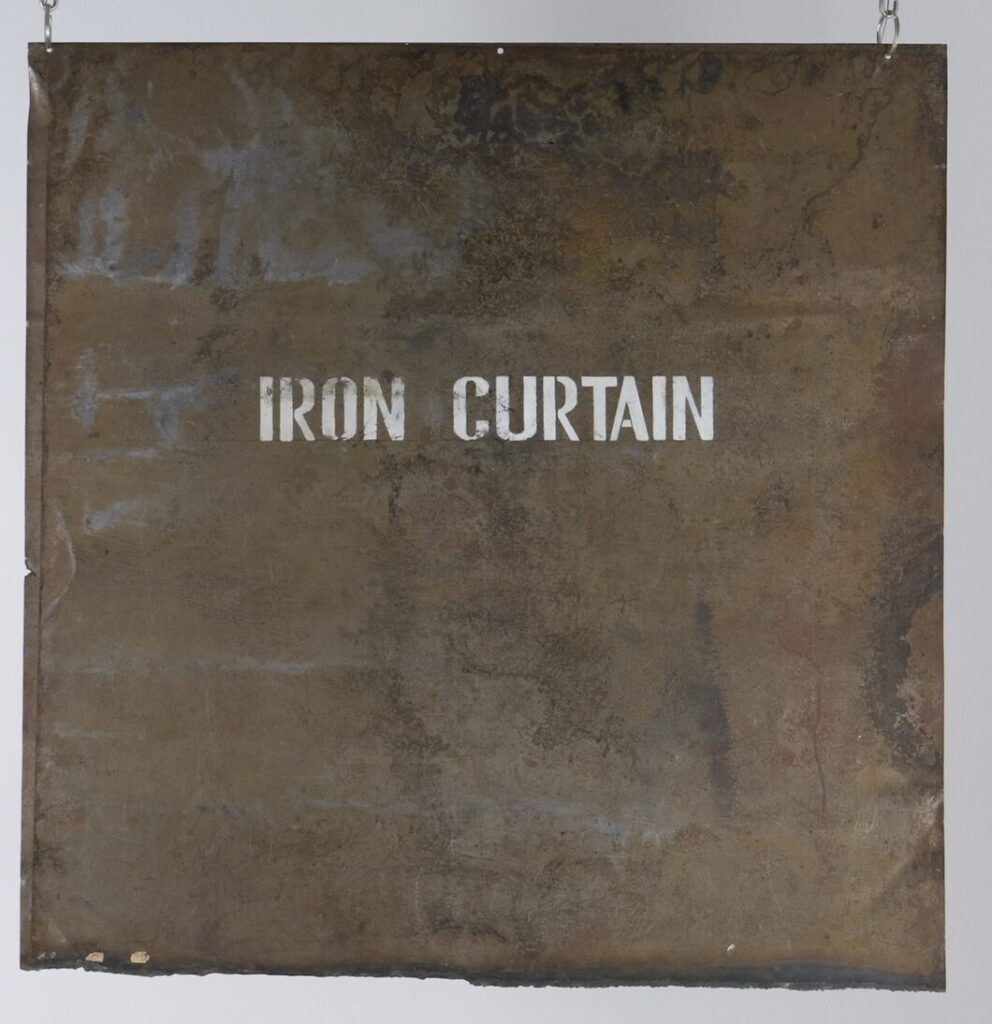
Železnyj zanaves The Iron Curtain, by the Gnezdo art group, 1976.
For the 2008 sequel to Assa, Solovyov invited Sergei Shnurov to be the film’s principal composer, while also featuring him in a cameo role. A prominent Russian musician and the frontman of the band Leningrad, Shnurov is known for his eccentric and provocative public persona, reflected in the songs characterized by satire and the extensive use of obscene language. It may be suggested that Solovyov saw in Shnurov the embodiment of a specific transition toward a “new” avant-garde (formally speaking), largely associated with the city of St. Petersburg – an avant-garde marked by provocation, a sort of “pop revolution,” experimentation and, ultimately, a dimension of social protest embodied by the band Leningrad itself.
Even when considered alongside its sequel, Assa remains an experimental film, a real manifestation of the late Soviet underground culture, a freewheeling collage – eclectic, polymorphous and multifaceted in nature – shaped by a wide range of creative influences; a work so radically improvised that it ultimately stands as the culmination of an era that was surprisingly open and tolerant on the verge of its demise. A work of art that could never have existed as we know it without the convergence of an extraordinary variety of artistic impulses and the key protagonists of its historical moment, whose true importance can only be partially captured in the present study.
________________
Notes
[1] The ‘Communication Pipe’ was originally conceived as “an effective way of improving communication between nations.”
[2] The temporal disjunction between these narrative strands seems to point toward a metafilmic dimension.
[3] The Russian term rok corresponds to the Latin fatum, which, in turn, evokes the Greek concept of Ananke – the personification of necessity, inevitability, and constraint – as embodied by the Moirai, the Fates who determine an inescapable destiny.
Bibliography
- Abdullaeva, Z., “2-Assa-2” Sergeia Solovyova: Zara Abdullaeva on tom, chto illiuzij bol’she net, “Iskusstvo kino”, 11.04.2023, URL: https://kinoart.ru/reviews/2-assa-2-sergeya-solovieva-zara-abdullaeva-o-tom-chto-illyuziy-bolshe-net (last accessed: 06/01/2026).
- Barabanov, B., Kniga peremen: dokumental’nyi roman B. Barabanova, in B. Barabanov, A. Chernigovskaya (eds.), St. Petersburg, Amfora, 2008.
- Bezenkova, M., Mifologizacija geroja i sredy v kinematografe perestrojki, “Vestnik Kazanskogo gosudarstvennogo universiteta kul’tury i iskusstv”, 1 (2019), pp. 85-89.
- Degot, E., Desyat aktsiy gruppy “Gnezdo”,2008, URL: https://os.colta.ru/art/projects/109/det ails/998/ (last accessed: 03/01/2024).
- Saprykin, Yu., Yurii Saprykin ob “Asse”: fragment iz novoi knigi “Solovyov”, “Iskusstvo kino”, 15.06.2022, URL: https://kinoart.ru/texts/yuriy-saprykin-ob-asse-fragment-iz-novoy-knigi-soloviev (last accessed: 06/01/2026).
- Lebedeva, Ju., Assa v massy, “ARTCHRONIKA”, 7-8 (2008).
- Mangiullo, A., “ASSA”: il fenomeno della Perestrojka, “Andergraund rivista”, URL: https://www.andergraundrivista.com/2021/12/20/assa-il-fenomeno-della-perestrojka/ (last accessed 18/01/2026).
- Morsin, A., “Mne s andegraundom interesnee, chem s Malerom”: Kak blagodarya Sergeyu Solovyovu poyavilis samye neveroyatnye rock-saundtreki kontsa 1980-kh., “Meduza”, 19.12.2021, 13 p., URL: https://meduza.io/feature/2021/12/19/mne-s-andegraundom-interesnee-chem-s-malerom (last accessed: 03/01/2026).
- Olenev, R., Sergey Solovyov, Andrey Larin (ed.), “Stop-kadr”, 22.06.2015, URL: https://newlit.ru/~olenev/5460.html (last accessed 18/01/2026) (my translation).
- Prigov D., Chto nado znat o kontseptualizme, “Art-Azbuka. Slovar sovremennogo iskusstva”, Fray (ed.), 1998, URL: http://azbuka.gif.ru/important/prigovkontseptualizm/ (last accessed: 01/01/2025).
- Semelyak, M., Saprykin, Yu., “Assa”: Vo vsem zasnezhennoe sirotstvo. “SEANS”, 05.04.2019, URL: https://seance.ru/articles/assa-2019/ (last accessed: 06/06/2025).
- Smirnova, A., Assa – v massy!, “Sovetskij Ėkran”, Ju. S. Rybakov (ed.), Moskva, Izdatel’stvo “Pravda”, 1988, pp. 12-14
- Solovyov, S., Dondurey, D., “Assu” v massy, massy v kassu… Ili Igrovoe Prostranstvo Parallelnoi Realnosti, “Iskusstvo kino”, K. Shcherbakov (ed.), 10/88, pp. 6-20.
- Stishova, E., Parol “ASSA”: Kak film Sergeya Solovyova stal manifestom pokoleniya Tsoya, “Iskusstvo kino”, 12/21, URL: https://kinoart.ru/opinions/parol-assa-pochemu-film-sergeya-solovieva-stal-manifestom-pokoleniya-tsoya (last accessed: 04/01/2025).
Online sources
Muzei Kino: “Assa” (1987), URL: https://www.museikino.ru/exposition/films/assa/ (last accessed: 06/04/2026).
Dokumentalnyi film “ASSA – 2024”, URL: https://www.youtube.com/watch?v=fN09qD61rew (last accessed: 06/04/2026).
Kulturnye kody neofitsialnogo iskusstva 1980-kh v filme “Assa”, URL: https://www.youtube.com/watch?v=zmoHwFwbmAU (last accessed: 06/04/2026).
@Sofiia Solokhina (Università di Pisa)
[25 gennaio 2026]
Sofiia Solokhina, Assa (1987). L’underground sul grande schermo, in Voci libere in URSS. Letteratura, pensiero, arti indipendenti in Unione Sovietica e gli echi in Occidente (1953-1991), a cura di Claudia Pieralli e Marco Sabbatini, Firenze, Firenze University Press, 2021-2026. ISSN 2704-5870 (online), eISBN 978-88-5518-463-2, DOI 10.36253/978-88-5518-463-2 https://vocilibereurss.fupress.net/assa/ (aggiornamento 31/01/2026)
 open access

